
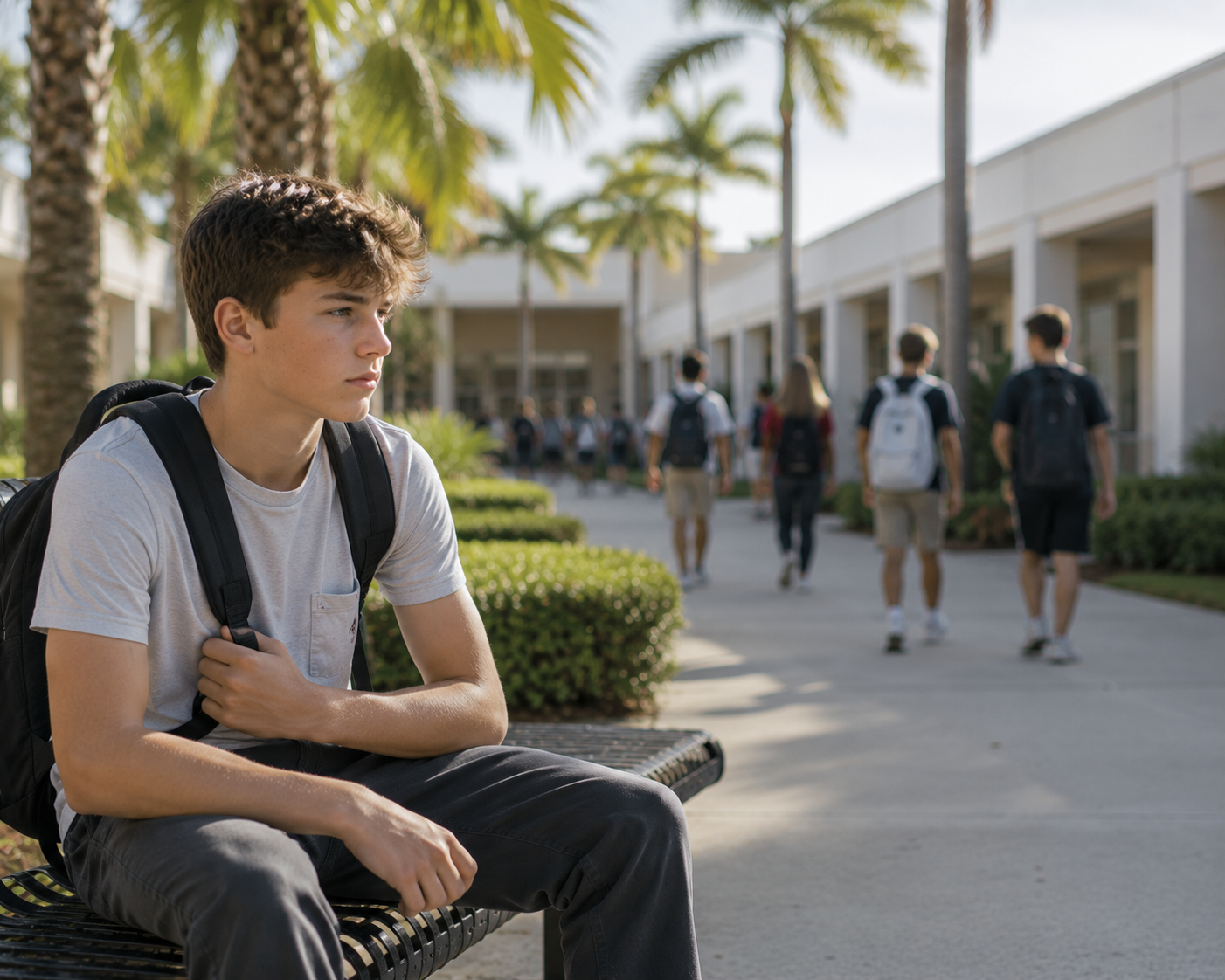
Anxiety in teen boys often looks nothing like worry. It looks like anger, avoidance, stomachaches, slipping grades, hours of gaming behind a locked door, and a one-word answer to every question you ask. Research from the National Institute of Mental Health shows that 26.1 percent of adolescent boys will experience an anxiety disorder, yet boys are significantly less likely than girls to be identified, diagnosed, or treated. The good news is unambiguous: with evidence-based treatment, most adolescents with anxiety improve substantially. This guide explains exactly what parents should look for and which treatments the clinical research supports.
Key Takeaways
– Roughly 1 in 4 teen boys (26.1 percent) will experience a diagnosable anxiety disorder during adolescence, according to the National Comorbidity Survey Adolescent Supplement.
– Anxiety in boys is frequently masked. It commonly presents as irritability, anger, physical complaints, school refusal, and withdrawal rather than visible worry.
– Boys are diagnosed and treated at lower rates than girls, not because they suffer less, but because their symptoms are misread as behavior problems.
– The strongest evidence supports cognitive behavioral therapy (CBT), often combined with SSRI medication. In the landmark CAMS trial, roughly 81 percent of youth responded to combined treatment.
– When outpatient care is not enough, residential treatment provides intensive daily therapy in a structured, gender-responsive environment.
– Braveminds Academy in Largo, Florida provides residential anxiety treatment designed specifically for boys ages 11 to 17. Call (888) 680-1807 for a confidential consultation.
How Common Is Anxiety in Teenage Boys?
Anxiety is the most common mental health condition of adolescence. The National Institute of Mental Health estimates that 31.9 percent of all adolescents ages 13 to 18 experience an anxiety disorder, and 8.3 percent experience anxiety severe enough to cause serious impairment in daily life.
For boys specifically, the lifetime prevalence is 26.1 percent. That means in a typical high school classroom of 30 students, roughly four of the boys are living with a diagnosable anxiety disorder right now. Federal survey data from 2023 found that 16.1 percent of adolescents ages 12 to 17 had a current anxiety diagnosis, a figure that has climbed steadily over the past decade. A 2021 meta-analysis published in JAMA Pediatrics found that clinically elevated anxiety symptoms in children and adolescents nearly doubled during the first year of the pandemic, and youth mental health systems are still absorbing that surge.
Yet CDC data consistently show fewer boys than girls carry a current anxiety diagnosis (9 percent versus 12 percent among youth ages 3 to 17). Clinicians who work with adolescent males see a gap in that data.
“The numbers tell us boys have less anxiety. Our clinical experience tells us boys have less *diagnosed* anxiety,” says Travis Atchison, PhD, LCSW-QS, MCAP, Clinical Director at Braveminds Academy. “Boys are socialized from an early age to convert vulnerable emotions into acceptable ones. Fear becomes anger. Worry becomes withdrawal. By the time a family reaches us, the anxiety has often been hiding in plain sight for two or three years, mislabeled as an attitude problem.”
 What Anxiety Looks Like in Teen Boys: 10 Warning Signs
 What Anxiety Looks Like in Teen Boys: 10 Warning Signs
Because boys tend to externalize distress, parents should watch for behavioral and physical signals rather than waiting to hear the words “I’m anxious.”
1. Irritability and anger outbursts. The most commonly missed sign. Anxiety keeps the nervous system on high alert, and in boys that arousal frequently discharges as a short fuse, slammed doors, or explosive reactions to small frustrations.
**2. Physical complaints without a medical cause.** Recurring headaches, stomachaches, muscle tension, and nausea, especially on school mornings or before performance situations, are classic somatic expressions of anxiety.
**3. Avoidance and school refusal.** Skipped classes, mysterious sick days, refusal to attend practices or social events. Avoidance temporarily relieves anxiety, which powerfully reinforces the behavior.
**4. Sleep disruption.** Trouble falling asleep because his mind will not shut off, frequent night waking, or daytime exhaustion despite adequate time in bed.
**5. Escape into screens.** Gaming, scrolling, and streaming become compulsive because they offer reliable, on-demand relief from an uncomfortable internal state.
**6. Perfectionism and procrastination.** These are two faces of the same fear. A boy who cannot start an assignment is often a boy terrified of doing it imperfectly.
**7. Declining grades and concentration problems.** Anxiety consumes working memory. Teachers may flag him as unmotivated or distracted when he is actually overwhelmed.
**8. Social withdrawal.** Dropping friend groups, eating lunch alone, quitting teams and activities he once loved.
**9. Reassurance-seeking or rigid routines.** Repeated questions like “Are you sure it will be okay?” or distress when plans change unexpectedly.
**10. Substance experimentation.** Some anxious teens discover that alcohol, marijuana, or vaping quiets the noise. Self-medication is a serious escalation signal that warrants prompt professional evaluation.
“Parents often ask me how to tell the difference between normal teenage moodiness and clinical anxiety,” Dr. Atchison notes. “The answer is function. Every teenager has bad days. When the behavior persists for weeks, shows up across settings like home, school, and friendships, and starts shrinking his world, that is no longer a phase. That is a treatable condition asking for attention.”
Why Boys’ Anxiety Goes Untreated
Research has long documented a treatment gap for adolescent anxiety: a majority of affected youth never receive care. For boys, three forces widen that gap. First, masculine norms teach boys that admitting fear is weakness, so they under-report symptoms even in a doctor’s office. Second, adults misattribute externalized anxiety to defiance, laziness, or ADHD. Third, screening tools were largely validated on symptom presentations more typical of girls, meaning boys can score below clinical thresholds while suffering significantly.
The cost of missing it is high. Untreated adolescent anxiety is a well-established risk factor for depression, substance use disorders, academic failure, and suicidal ideation in later adolescence and adulthood. Early intervention changes that trajectory.
Evidence-Based Treatments for Teen Anxiety
Cognitive Behavioral Therapy (CBT)
CBT is the first-line psychological treatment for adolescent anxiety disorders and the most extensively researched. It teaches teens to identify distorted threat appraisals, test them against reality, and gradually face avoided situations through structured exposure exercises. Exposure work is the active ingredient: avoidance feeds anxiety, and carefully sequenced practice starves it.
Medication (SSRIs)
Selective serotonin reuptake inhibitors are the medication class with the strongest evidence for pediatric anxiety. The Child/Adolescent Anxiety Multimodal Study (CAMS), a landmark randomized controlled trial published in the New England Journal of Medicine, compared treatments in 488 youth ages 7 to 17 with separation, social, or generalized anxiety disorders. Approximately 81 percent of participants receiving combined CBT and sertraline were rated much or very much improved, compared with roughly 60 percent for CBT alone, 55 percent for medication alone, and 24 percent for placebo.
“Medication is never the whole plan, but for moderate to severe anxiety it can be the bridge that makes therapy possible,” explains W. Nate Upshaw, MD, Medical Director at Braveminds Academy. “When a boy’s nervous system is stuck in overdrive, an appropriately prescribed and carefully monitored SSRI can lower the baseline enough for him to actually engage with the therapeutic work. The research consistently shows the combination outperforms either approach alone.”
Family Involvement
Adolescent anxiety lives in a family system. Well-meaning accommodation, such as letting him skip school, answering for him, or removing every stressor, provides short-term peace while strengthening the disorder. Effective treatment coaches parents to support courage rather than accommodate avoidance, and studies show family involvement improves outcomes and reduces relapse.
Lifestyle and Skills Foundations
Sleep regularity, daily physical activity, reduced caffeine and energy drink intake, structured screen boundaries, and mindfulness-based skills all have supporting evidence as adjuncts. They are rarely sufficient alone for a clinical anxiety disorder, but they meaningfully amplify formal treatment.
Residential Treatment: When Outpatient Care Is Not Enough
For some boys, weekly outpatient therapy cannot gain traction. Warning signs that a higher level of care may be needed include school refusal lasting weeks or months, anxiety accompanied by escalating depression or self-harm, substance use, complete social withdrawal, or repeated outpatient attempts that stall.
Residential treatment immerses a teen in a therapeutic environment with daily individual and group therapy, psychiatric oversight, academic support, and peers doing the same hard work. For boys specifically, a gender-responsive setting removes a major barrier: the social pressure to perform toughness in front of an audience he is trying to impress.
“There is something that happens when a boy sits in a group with other boys and hears someone he respects say out loud, ‘I was scared,'” says Dr. Atchison. “The permission that creates is clinically powerful. It is very difficult to replicate in a 50-minute weekly session.”
How Braveminds Academy Treats Anxiety in Teen Boys
Braveminds Academy is a residential mental health treatment program in Largo, Florida, serving boys ages 11 to 17 from across the country. Our clinical model combines evidence-based individual therapy including CBT, daily group therapy, psychiatric evaluation and medication management under the direction of W. Nate Upshaw, MD, family therapy to align the home environment with treatment goals, and continued academics so treatment does not cost a boy his school year.
Every element of the program is designed around how adolescent males actually engage: experiential, active, relationship-first, and free of the performance pressure of a mixed setting.
If you are seeing the signs described in this article, you do not have to figure out the next step alone. Call our admissions team at **(888) 680-1807** for a confidential, no-obligation consultation, or visit our admissions page to learn more.

Dr. W. Nate Upshaw is a psychiatrist with over 20 years of experience across inpatient psychiatry, VA hospitals, academic medicine, and private practice. A Tulane University School of Medicine graduate and former University of South Florida faculty member, he specializes in complex and treatment-resistant conditions, including PTSD, depression. He is also trained in advanced interventional treatments such as TMS, ECT, and Spravato®, and currently serves as Medical Director at Braveminds Academy as well as Turnwell Mental Health of Charleston and Tampa Bay, focusing on personalized, high-precision psychiatric care.