
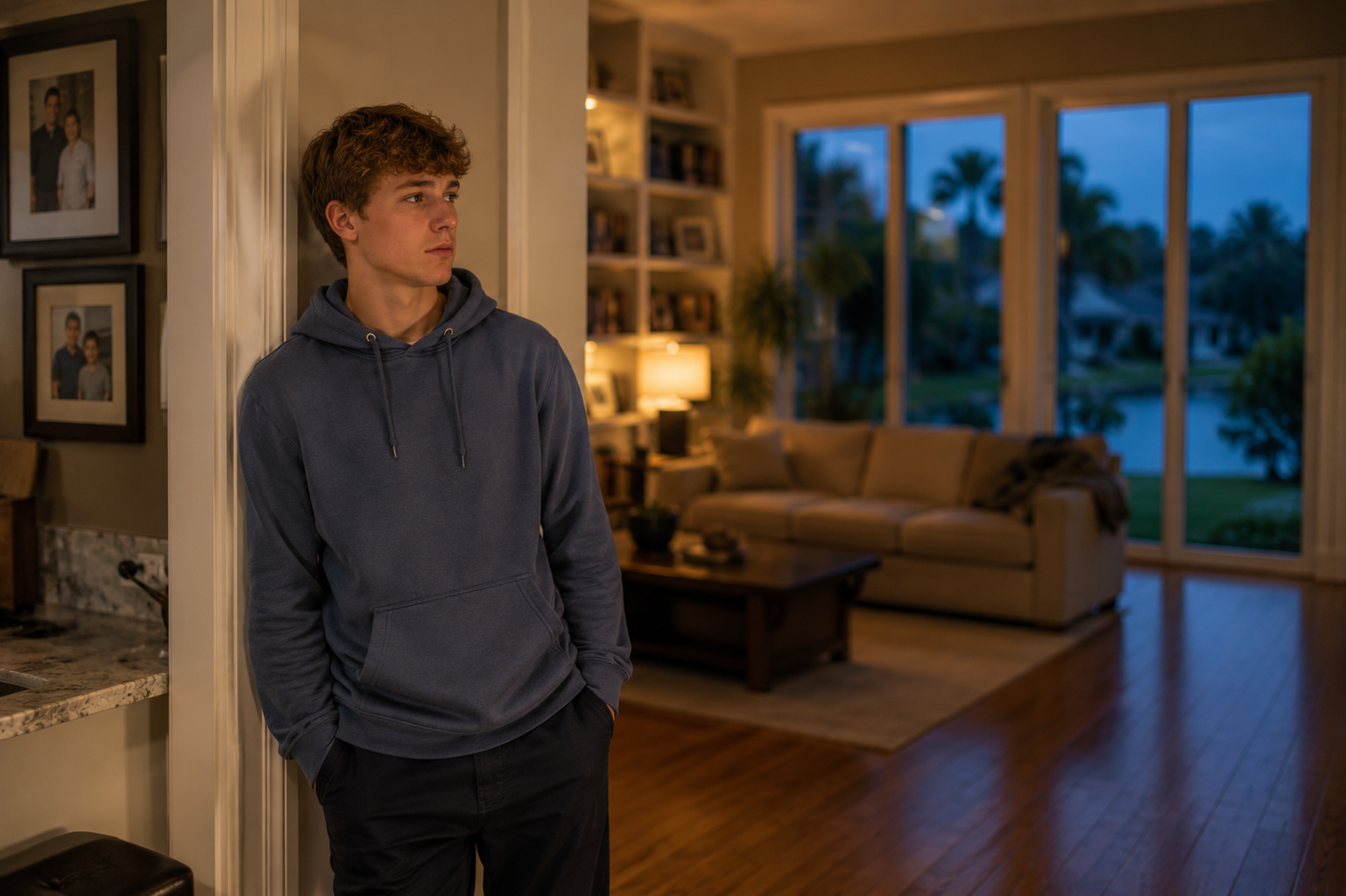
If you typed some version of “my son is angry all the time” into a search bar, you are asking the single most common question parents of teenage boys bring to clinicians. Here is the answer up front: chronic anger in an adolescent boy is a signal, not a personality, and it has a short list of likely sources. Sometimes it is oppositional defiant disorder (ODD), a real diagnosis affecting roughly 3.3 percent of youth per the DSM-5-TR. Just as often, the anger is the visible surface of something underneath: anxiety, depression, ADHD, or a screen-use battle that has consumed the household. CDC data show boys carry current diagnosed behavior disorders at twice the rate of girls (10 percent versus 5 percent). The work, and the hope, lies in figuring out which problem you are actually looking at, because every one of them is treatable.
Key Takeaways
- Chronic anger and defiance in teen boys has a differential: ODD, anxiety, depression, ADHD, and compulsive screen use can all present as an angry, defiant boy. Accurate diagnosis drives everything.
- ODD is a genuine diagnosis, defined by a persistent pattern (6 months or more) of angry/irritable mood, argumentative and defiant behavior, and vindictiveness. DSM-5-TR prevalence is 3.3 percent, with boys at roughly 1.6 times the risk of girls.
- CDC data show 10 percent of boys ages 3 to 17 have a current diagnosed behavior or conduct disorder, twice the rate of girls.
- Research shows the irritable-mood dimension of ODD predicts later anxiety and depression, while the defiant-behavior dimension predicts conduct problems. Anger is a fork in the road, and early treatment changes which path a boy takes.
- The strongest treatment evidence is behavioral and family-based: Parent Management Training and Collaborative and Proactive Solutions lead the evidence base. There is no FDA-approved medication for ODD itself.
- Braveminds Academy in Largo, Florida provides residential treatment for boys ages 11 to 17 whose anger has escalated beyond what outpatient care can hold. Call (888) 680-1807 for a confidential consultation.
Is It a Phase, a Disorder, or a Mask? The Three Questions That Sort It Out
Every teenage boy is sometimes moody, argumentative, and allergic to being told what to do. Clinicians separate normal adolescence from a clinical problem with three questions.
How long has it lasted? ODD requires a pattern of at least 6 months. A rough semester after a move or a breakup is a stressor response. A year of daily battles is a pattern.
How many settings does it show up in? Anger that appears only at home often points to a family-system dynamic or a specific conflict, frequently around screens. Anger at home, at school, and with peers points to something inside the boy.
What does it cost him? Detentions, suspensions, lost friendships, family relationships in ruins. When the anger is shrinking his life and he cannot stop even when he wants to, it has crossed the clinical line.
“Parents come in saying my son is angry all the time, and the most important thing I can tell them is that sentence is a starting point, not a diagnosis,” says Travis Atchison, PhD, LCSW-QS, MCAP, Clinical Director at Braveminds Academy. “Anger is the check-engine light of adolescent boys. It is the one emotion they have full social permission to express, so everything else gets routed through it. Our job is to open the hood. Sometimes we find ODD. At least as often we find an anxious kid, a depressed kid, or an ADHD kid who has been in trouble so long that fighting the world has become his identity.”
What Oppositional Defiant Disorder Actually Is
ODD is a persistent pattern of angry or irritable mood, argumentative and defiant behavior toward authority figures, and vindictiveness, lasting at least 6 months and impairing functioning. The DSM-5-TR places prevalence at 3.3 percent of youth, with community estimates typically running 3 to 6 percent, and clinical samples much higher. Boys carry roughly 1.6 times the risk of girls, and lifetime data from the National Comorbidity Survey Replication suggest about 1 in 10 people meet criteria at some point before adulthood.
Two facts about ODD matter more than any others for parents.
First, ODD rarely travels alone. Comorbidity is the rule: CDC data show almost half of children with ADHD have a co-occurring behavior or conduct problem, and research consistently finds elevated anxiety and depression in youth with ODD.
Second, the symptoms themselves point in different directions. A well-replicated line of research shows that the angry/irritable mood dimension of ODD predicts later anxiety and depression, while the headstrong/defiant dimension predicts later conduct problems. In plain language, the boy who simmers and explodes is often on an internalizing path, and the boy who coldly refuses and retaliates is on an externalizing one. They need different emphasis in treatment, which is exactly why a real diagnostic evaluation beats a label.
What Anger Is Often Masking: The Differential Every Parent Should Know
Before concluding a boy “is” oppositional, rule in or out the four conditions that most often wear anger as a costume.
Anxiety. An anxious boy’s nervous system lives on high alert, and in boys that arousal discharges as a short fuse. The tell: the explosions cluster around demands and transitions, school mornings, new situations, performance moments. He is not defying you. He is cornered.
Depression. In adolescents, the DSM-5 explicitly allows irritable mood to stand in for depressed mood, and in boys it usually does. The tell: the anger comes with anhedonia, withdrawal, sleep collapse, and “nothing matters.” The fight has despair underneath it.
ADHD. Emotional dysregulation, frustration intolerance, and impulsive outbursts are core features of adolescent ADHD, and years of correction and failure add a layer of accumulated resentment. The tell: the anger is fast, disproportionate, and quickly regretted, and it sits alongside executive dysfunction and inconsistent performance.
Screen conflict. For some families, nearly every explosion detonates at the same trigger: limits on gaming or the phone. Rage when access is removed can indicate problematic use that needs its own evaluation, and the nightly standoff itself becomes a family wound. The tell: subtract the screen battles and the anger largely disappears.
“The referral says defiant. It almost never says scared, or hopeless, or ashamed,” Dr. Atchison notes. “But sit with these boys long enough and that is what you find under the armor. I tell parents: your son’s anger is information. The question is never just how do we stop the behavior. It is what is the behavior doing for him, and what would he have to feel if he stopped.”

10 Signs Anger Has Crossed the Clinical Line
1. Frequency and duration. Losing his temper multiple times a week, most weeks, for 6 months or more.
2. Arguments with every authority. Not one hated teacher, but a pattern with parents, teachers, coaches, and anyone holding a rule.
3. Deliberate provocation. Actively annoying others and enjoying the reaction, or blaming everyone else for his behavior, every time.
4. Vindictiveness. Holding grudges, seeking payback, spite that outlasts the conflict.
5. Escalating intensity. Yelling has become slamming, slamming has become holes in walls or broken belongings.
6. School consequences piling up. Detentions, suspensions, calls home, threatened expulsion.
7. The family walking on eggshells. Siblings avoiding him, parents pre-managing his moods, the household organized around preventing the next eruption.
8. Friendships burning down. Peers pulling away, conflicts with friends, migration toward other angry or high-risk kids.
9. Remorse shrinking. Early on, most boys feel bad after blowups. Watch for apologies disappearing and justification taking their place.
10. Any physical aggression, cruelty, destruction, or law-breaking. Aggression toward people or animals, stealing, fire-setting, or running away moves the conversation from ODD toward conduct disorder and requires prompt professional evaluation.
A safety note: anger turned inward matters as much as anger turned outward. If rage episodes come with hopeless talk, self-harm, or any statement about being better off gone, treat it as a depression emergency. Call or text the 988 Suicide and Crisis Lifeline, available 24 hours a day.
Evidence-Based Treatments for Anger, Defiance, and ODD
Parent Management Training (PMT)
The most extensively validated treatment for oppositional behavior, with decades of trials behind it. PMT works on a counterintuitive premise: the fastest way to change a boy’s behavior is to change what surrounds it. Parents learn to starve the conflict cycle, reinforce cooperation deliberately, give commands that can actually be followed, and apply calm, consistent, non-negotiable consequences. It is not about being harsher. Research on coercive family process shows harshness feeds the cycle.
Collaborative and Proactive Solutions (CPS)
Built on the premise that kids do well if they can, CPS treats chronic defiance as lagging skills, in flexibility, frustration tolerance, and problem-solving, rather than attention-seeking. Parent and child solve recurring flashpoints together in advance. In a randomized controlled trial comparing CPS directly with PMT in youth with ODD, both treatments produced significant improvement, giving families two evidence-based roads.
Treating What the Anger Is Masking
When evaluation finds anxiety, depression, or ADHD underneath, treating that condition is not a detour from treating the anger. It frequently is the treatment. CBT for the anxious boy, combined evidence-based care for the depressed boy, medication optimization and skills training for the ADHD boy, each one drains the reservoir the anger has been drawing from.
Medication, Honestly
There is no FDA-approved medication for ODD itself, and parents should be wary of anyone implying otherwise. Medication enters the picture when it targets a co-occurring condition, and treating co-occurring ADHD in particular often reduces oppositional behavior substantially.
Individual Skills Work
CBT-based anger management, emotion identification, and regulation skills help boys catch the fuse earlier. For adolescent boys specifically, this works best embedded in activity and relationship rather than delivered as a lecture across a desk.
Residential Treatment: When the Home System Is Exhausted
Consider a higher level of care when aggression is escalating toward or past the physical line, when school placement is collapsing, when co-occurring depression, anxiety, or substance use has entered the picture, when siblings are no longer safe or the family has reorganized itself around the anger, or when outpatient treatment keeps failing because every session is relitigating the week’s battles. Residential treatment interrupts the coercive cycle completely: the boy works with clinicians who have no history in his war, parents get coached without daily combat, and the family reunites around new patterns instead of old scar tissue.
“By the time families reach us, the anger has usually become the relationship. Every interaction is enforcement, negotiation, or ceasefire,” Dr. Atchison says. “Residential treatment gives everyone the one thing they cannot get at home, which is distance from the pattern. The boy discovers who he is with adults he has no history with. The parents remember who their son was. Then we rebuild the bridge, deliberately, with new materials.”
How Braveminds Academy Treats Anger and Defiance in Teen Boys
Braveminds Academy is a residential mental health treatment program in Largo, Florida serving boys ages 11 to 17. For angry and defiant boys, our model starts where this article does, with a comprehensive psychiatric and psychological evaluation under the direction of W. Nate Upshaw, MD, to establish what the anger actually is. Treatment combines daily individual and group therapy building emotional regulation and frustration tolerance, targeted treatment of co-occurring anxiety, depression, or ADHD, structured parent coaching so the home he returns to runs on new patterns, and academics that continue while the clinical work happens.
“An angry boy walks in expecting one more institution to fight,” says W. Nate Upshaw, MD, Medical Director at Braveminds Academy. “What changes him is discovering that nobody here is interested in winning against him. The evaluation tells us what we are treating. The relationships do the treating. Anger this persistent was never a character flaw. It is a solvable clinical problem, and families should hear that plainly.”
If your family is living around your son’s anger, you do not have to keep absorbing it alone. Call our admissions team at (888) 680-1807 for a confidential, no-obligation consultation.

Dr. W. Nate Upshaw is a psychiatrist with over 20 years of experience across inpatient psychiatry, VA hospitals, academic medicine, and private practice. A Tulane University School of Medicine graduate and former University of South Florida faculty member, he specializes in complex and treatment-resistant conditions, including PTSD, depression. He is also trained in advanced interventional treatments such as TMS, ECT, and Spravato®, and currently serves as Medical Director at Braveminds Academy as well as Turnwell Mental Health of Charleston and Tampa Bay, focusing on personalized, high-precision psychiatric care.