
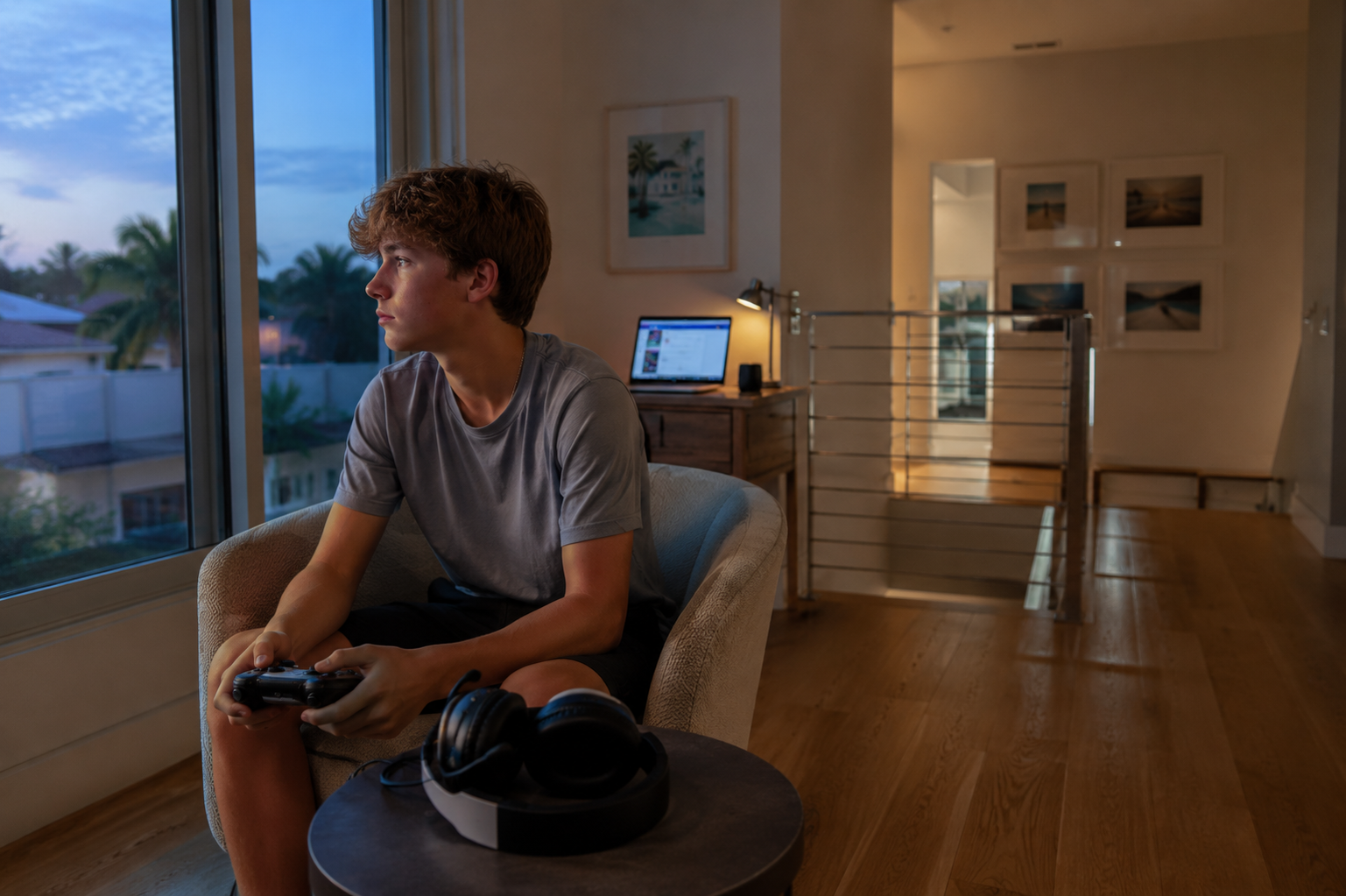
The question parents ask most is “how many hours is too many?” The honest clinical answer is that hours are the wrong measurement. The World Health Organization officially recognized gaming disorder in the ICD-11, effective January 2022, and its criteria say nothing about a specific number of hours. They describe impaired control, gaming taking priority over other life interests, and continued gaming despite negative consequences, persisting for at least 12 months. By those criteria, most heavy gamers do not have a disorder, and some boys logging fewer hours than their friends absolutely do. This guide explains where the clinical line actually sits, why boys are disproportionately affected, what compulsive screen use is usually hiding, and which treatments the evidence supports.
Key Takeaways
- Gaming disorder is a real medical diagnosis. The WHO added it to the ICD-11, effective 2022. It is defined by impaired control, escalating priority, and continued use despite harm, not by hours played.
- “Social media addiction” is not a formal diagnosis, but problematic use is real and measurable. The U.S. Surgeon General’s 2023 advisory reported that adolescents spending more than 3 hours daily on social media face double the risk of depression and anxiety symptoms, and teens average about 3.5 hours a day.
- Boys are disproportionately affected by gaming problems. Large multi-country adolescent studies consistently find substantially higher problem-gaming rates in boys than girls.
- Prevalence estimates for adolescent gaming disorder vary widely by study and instrument, from roughly 1 to 6 percent in rigorous epidemiological work, meaning most gamers are fine and a meaningful minority are not.
- Compulsive gaming in teen boys is usually a symptom, not the root problem. It most often functions as an escape from anxiety, depression, ADHD, or social pain, and treating only the screen misses the point.
- Braveminds Academy in Largo, Florida provides residential treatment for boys ages 11 to 17 whose compulsive screen use is entangled with underlying mental health conditions. Call (888) 680-1807 for a confidential consultation.
Is Gaming Addiction Real? What the Diagnoses Actually Say
Parents deserve precision here, because this topic attracts more hype than almost any other in adolescent mental health.
Gaming disorder is an official diagnosis. The World Health Organization included it in the 11th revision of the International Classification of Diseases, in effect since January 2022. The core criteria are impaired control over gaming, increasing priority given to gaming over other activities and interests, and continuation or escalation of gaming despite negative consequences, typically evident over at least 12 months. The American Psychiatric Association’s DSM-5 lists the related concept of internet gaming disorder as a condition warranting further study.
Social media addiction, by contrast, is not a formal diagnosis in either the ICD-11 or the DSM-5. That does not make problematic use imaginary. Researchers have validated ICD-11-modeled instruments for social media use disorder, with studies finding roughly 2.6 to 3.3 percent of adolescents meeting pathological-use criteria, and the U.S. Surgeon General issued a formal advisory in 2023 warning about social media’s mental health risks for youth, followed in 2024 by a call for warning labels on platforms.
“Parents lose credibility with their sons when they call everything addiction, and clinicians lose credibility with parents when they dismiss everything as normal teen behavior,” says Travis Atchison, PhD, LCSW-QS, MCAP, Clinical Director at Braveminds Academy. “The truth is in the middle and it is measurable. We are not asking how much he plays. We are asking what happens to his life when he plays, and what happens to him when he cannot.”
How Common Is It, and Why Boys?
Honest answer: the research range is wide. Rigorous epidemiological studies of adolescent gaming disorder report prevalence roughly between 1.2 and 5.9 percent, with a validated ICD-11 instrument finding 2.27 percent in a large adolescent sample. Some recent meta-analyses pooling looser screening measures report higher figures, which mostly tells us the field’s instruments vary. What the research does not dispute is the sex difference: large multi-country studies of adolescents, including a 12-region European sample of more than 44,000 youth, consistently find substantially higher problem-gaming symptoms in boys than girls.
The intensity data are also instructive. Research comparing at-risk gamers with recreational gamers found the at-risk group averaged around 42 hours per week, against roughly 24 to 26 hours for gamers not at risk. Both numbers may startle parents. The clinical difference lies in function and consequences, not in the raw total.
On the social media side, the Surgeon General’s advisory reports that up to 95 percent of teens ages 13 to 17 use social media, more than a third describe using it almost constantly, and adolescents exceeding 3 hours daily face double the risk of depression and anxiety symptoms. Girls carry heavier documented harms around body image and cyberbullying-related depression. For boys, social media harm more often rides alongside gaming: algorithmic video feeds, gaming content, group chats built around the game, and gambling-adjacent mechanics such as loot boxes.
“For the boys we treat, the game is rarely just a game. It is a social life, a status system, and an anesthetic all in one,” Dr. Atchison notes. “He is competent there in a way he may not feel anywhere else. When a boy tells me the only place he does not feel anxious is in the game, that sentence is the whole clinical picture.”
10 Warning Signs Gaming or Social Media Use Has Crossed the Line
1. Loss of control. He genuinely cannot stop at agreed limits, even limits he set himself. Sessions intended to last an hour swallow the night.
2. Displacement of everything else. Sports, friends, family dinners, and former interests fall away one by one until the screen is the last activity standing.
3. Continued use despite real consequences. Failing grades, lost friendships, family blowups, and he keeps playing anyway. This is the defining ICD-11 feature.
4. Rage or despair when access is removed. Not ordinary teenage annoyance, but explosive anger, panic, or hopelessness when the router goes off. Intense withdrawal-like reactions signal dependency on the activity for emotional regulation.
5. Sleep collapse. Gaming or scrolling until 2 or 3 a.m., chronic exhaustion, sleeping through weekend daylight.
6. Deception. Hidden devices, secret accounts, lying about play time, spending money on in-game purchases without permission.
7. Physical neglect. Skipped meals or constant snacking at the desk, declining hygiene, headaches, and no physical activity.
8. Mood dependent on the screen. Good days and bad days are determined by in-game outcomes or online interactions rather than real-world events.
9. Total social migration. All friendship exists inside the game or the group chat. In-person invitations are refused because they compete with online commitments.
10. Use as the only coping tool. Every difficult emotion, boredom, anxiety, sadness, anger, routes immediately to the screen. Nothing else regulates him anymore.

What Compulsive Gaming Is Usually Hiding
This is the most important section of this article for parents. In clinical practice, severe compulsive gaming in adolescent boys is rarely a standalone problem. It is far more often the visible coping strategy for an underlying condition: social anxiety that makes online interaction feel safe and in-person interaction feel dangerous, depression that makes the game the only remaining source of reward, ADHD brains drawn to the rapid feedback loops games are engineered to deliver, or grief, trauma, and bullying that make escape rational.
Research on adolescents with gaming problems consistently documents high rates of co-occurring psychiatric conditions, and games themselves are built with intermittent reward systems that make them exceptionally effective, and exceptionally sticky, as emotional anesthesia.
“If you confiscate the Xbox and do nothing else, you have not treated anything. You have removed a symptom and left the disease,” says W. Nate Upshaw, MD, Medical Director at Braveminds Academy. “The gaming was doing a job. Our task is to figure out what job, treat the underlying condition, whether that is anxiety, depression, or ADHD, and then help him build a life that competes with the screen. Sequence matters, and it starts with a real diagnostic evaluation, not a router password.”
Evidence-Based Treatment for Gaming and Screen Problems
Cognitive Behavioral Therapy
CBT adapted for internet gaming disorder has the strongest evidence base of any intervention studied, targeting the thought patterns, triggers, and reinforcement loops that drive compulsive use while building competing skills and activities. Meta-analytic reviews support CBT for reducing gaming disorder symptoms and related depression.
Treating the Underlying Condition
Because compulsive use so often rides on anxiety, depression, or ADHD, comprehensive treatment starts with full psychiatric evaluation. There is no FDA-approved medication for gaming disorder itself, and any clinic implying otherwise should be avoided, but treating a co-occurring condition with evidence-based therapy and, where appropriate, medication frequently loosens the screen’s grip substantially.
Family Therapy and Structured Limits
Screen conflict is a family-system problem by the time it reaches a clinic. Effective treatment coaches parents to move from the nightly power struggle to consistent, negotiated structure, and research on adolescent behavioral problems consistently shows family involvement improves outcomes. Abstinence is usually not the goal; regulated, values-consistent use is, since screens are permanent features of modern life and school.
Replacement, Not Just Removal
Sustainable recovery requires rebuilding the real-world sources of what the game provided: competence, status, social belonging, and stimulation. Sports, strength training, outdoor adventure, music, and skill mastery are not extras in treatment. They are the treatment.
Residential Treatment: When Outpatient Care Is Not Enough
Consider a higher level of care when a boy’s screen use involves rage or aggression when limited, complete school refusal or academic collapse, day-night reversal, co-occurring depression, anxiety, or self-harm, or when every outpatient attempt has dissolved into the same nightly standoff. A residential setting does what no home can: it changes the entire environment at once, providing a structured, screen-regulated daily rhythm, immediate psychiatric evaluation of what the gaming was masking, daily therapy, and a peer group of boys rebuilding real-world lives together.
“At home, the argument about the screen becomes the relationship. That is corrosive for everyone,” Dr. Atchison says. “In residential treatment the argument simply is not available, and within a couple of weeks something interesting happens. The boy who could not live without the game is playing basketball, sleeping at night, and talking in group. Then the real work can start, because now we can see who he is without the anesthesia.”
How Braveminds Academy Helps
Braveminds Academy is a residential mental health treatment program in Largo, Florida serving boys ages 11 to 17. For boys with compulsive gaming or screen use, our model combines comprehensive psychiatric evaluation to identify what the screen use is masking, under the direction of W. Nate Upshaw, MD, daily individual and group therapy including CBT, a structured, active daily schedule that rebuilds sleep, exercise, and real-world engagement, academic recovery, and family therapy that replaces the screen standoff with workable structure before he returns home.

Dr. W. Nate Upshaw is a psychiatrist with over 20 years of experience across inpatient psychiatry, VA hospitals, academic medicine, and private practice. A Tulane University School of Medicine graduate and former University of South Florida faculty member, he specializes in complex and treatment-resistant conditions, including PTSD, depression. He is also trained in advanced interventional treatments such as TMS, ECT, and Spravato®, and currently serves as Medical Director at Braveminds Academy as well as Turnwell Mental Health of Charleston and Tampa Bay, focusing on personalized, high-precision psychiatric care.